Desk and Bookcase

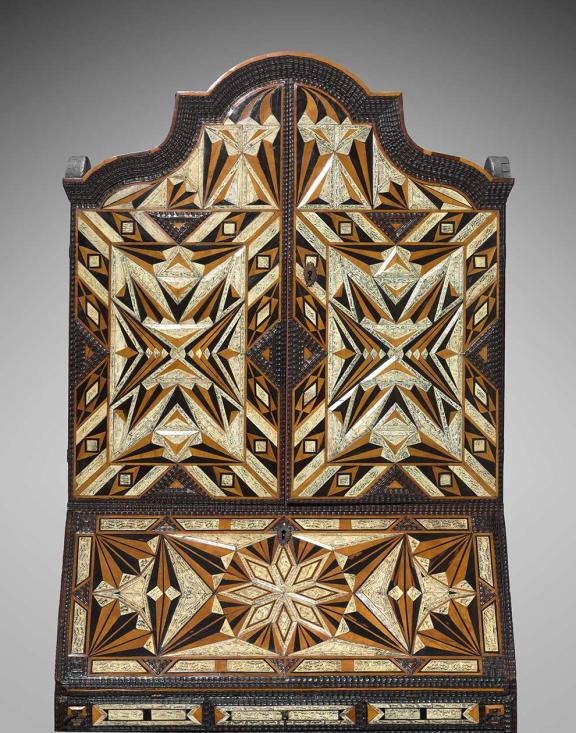
Mexican artists, desk and bookcase, mid-18th century. Inlaid woods and incised and painted bone, maque, gold, and polychrome paint, metal hardware. Henry H. and Zoe Oliver Sherman Fund.
Mexican artists, desk and bookcase, mid-18th century. Inlaid woods and incised and painted bone, maque, gold, and polychrome paint, metal hardware. Henry H. and Zoe Oliver Sherman Fund.
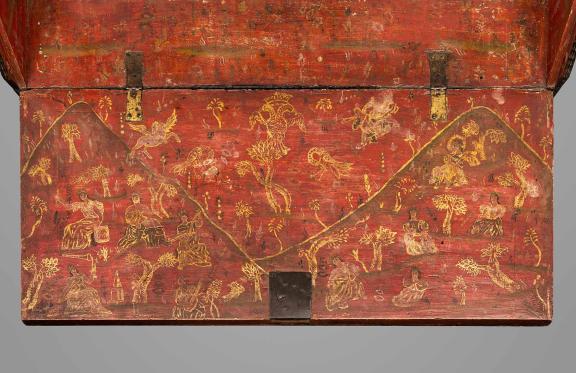
This summer, upon taking your first steps into the reimagined 18th-century galleries in the MFA’s Art of the Americas Wing, you’ll find yourself facing a grand, elaborately decorated desk. Its panels will be swung open to reveal a burst of bright red, over which a curious map is painted in gold. After glancing at the wall label, you’ll discover that this desk comes from the city of Puebla, Mexico. You may then ask yourself why it’s featured so prominently among some of the best-known works of American art from the 1700s.
The answer lies in how the MFA defines the term “America.” Rather than describing the history and culture of what is now the United States, we consider art of the Americas to encompass the Western Hemisphere, from the southern tip of Argentina to the northernmost territories of Canada. With this definition in mind, we set out to tell the histories of the Americas in their entirety through objects.
While developing the new galleries, we faced the challenge of integrating objects that tell North America’s British colonial story with art from the Spanish colonial Americas, where independence movements didn’t ignite until the 19th century. To resolve this, we looked beyond the mismatched political timelines to focus on what these regions had in common: the legacy of Indigenous societies encountering colonial imposition, shared global trade routes, and international artistic trends. We had to get creative to tell this shared story through our collection—and the Puebla desk is nothing if not creative.
This desk, which is one of a nearly identical pair (its twin resides in a museum in Puebla), contains a world’s worth of styles in one object. On its exterior, geometric designs of etched bone and different-colored woods resemble the Islamic aesthetics that heavily influenced Spain and Spanish America for centuries. These are contrasted with undulating moldings—known as ripple moldings, a popular Dutch woodworking technique—around the desk’s outer edges. The sides have thin swirls of inlaid wood that transform into tulips and leaves, inspired by decorative traditions in central and northern Europe. Throughout the bright-red interior, distinct map paintings simultaneously echo Asian aesthetics and Indigenous Mesoamerican mapmaking traditions. The maps chart landholdings of the Rivadeneira family, who commissioned the desk—probably to flaunt the lands they considered their rightful possession (they were in a land dispute at the time). These included the site of one of the earliest free Black settlements in Mexico, established at the beginning of the 17th century as the town of San Lorenzo de Cerralvo. The maps even depict descendants of San Lorenzo who worked on the Rivadeneira estate.
The diverse styles comprising this desk embody our goal of presenting shared experiences across the Americas. Much like the lacquering and wood inlay techniques that British North American cabinetmakers used to create unique forms of American furniture, Puebla’s cabinetmakers developed their own grandiose new methods. Different hands probably drew the maps, which required an entirely different set of skills. Artists and craftspeople possessing special skills from all the corners of the globe converged in Puebla, the second-largest city in colonial Mexico—this desk is just one of the extraordinary pieces they created.
This object is a personal touchstone and represents a key reason why I work at the MFA. As a specialist in Latin American art, I was hopeful about how my expertise would integrate into a department historically defined by its eminent British North American and US collections, but increasingly dedicated to expanding its scope. By placing this Mexican masterwork alongside counterparts from British North America, the MFA is delivering on the commitment it made more than 25 years ago when it established the Art of the Americas department. To me, this desk is much more than a piece of furniture; it is a vivid, physical statement that our shared story of America has always been interconnected.
Further Reading
Carr, Dennis. “The Spanish colonial world in microcosm: a Puebla desk-and-bookcase.” In Cannady, Lauren R., and Jennifer Ferng, eds. Crafting Enlightenment: Artisanal Histories and Transnational Networks. Oxford University Studies in the Enlightenment. Liverpool University Press, 2021.