Meeting Bench

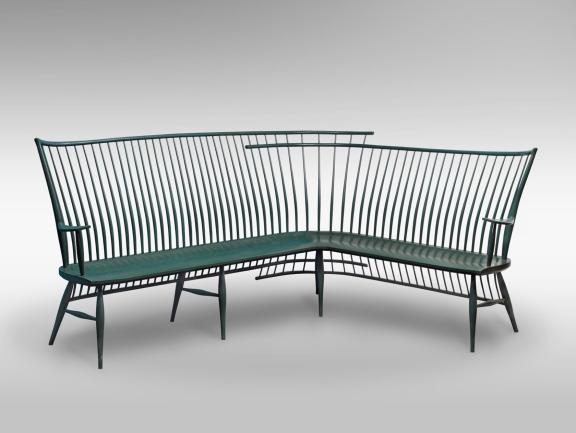
Aspen Golann and Peter Galbert, Meeting Bench (in situ), 2025. Hard maple, hickory, milk paint. Museum purchase with funds donated by the Gallery Instructors. © Aspen Golann and Peter Galbert.
Aspen Golann and Peter Galbert, Meeting Bench (in situ), 2025. Hard maple, hickory, milk paint. Museum purchase with funds donated by the Gallery Instructors. © Aspen Golann and Peter Galbert.
The MFA’s Please Be Seated program turned 50 last year. In recognition of this milestone, the Museum invited us to create new functional gallery seating for visitors that doubles as a work of art in the collection. Our resulting creation, Meeting Bench, draws inspiration from 1700s Windsor chairs—one of the most successful and ubiquitous seating forms in North American history, with strong ties to Boston. While referencing traditional styles, we introduced contemporary elements such as broken lines, overlapping backs, and curved planes.
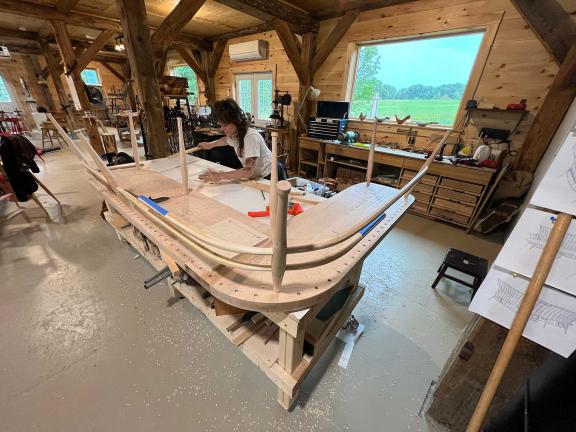
We created Meeting Bench by hand, embracing a collaborative spirit with contributions from friends and colleagues. The materials and processes we used don’t just reflect tradition, they enabled us to achieve results that would be limited by other means. We constructed the chair using green wood, which, simply put, means that you start with a recently felled log rather than dried boards available at lumber stores. Green wood is flexible and strong, allowing for an end result that is less rigid and more comfortable than a machine-made bench. The process of building with green wood is also efficient—we were able to work much faster than a production shop would have been able to—encouraging rapid iteration and development. Plus, the many surprises and benefits that come with this material and method make it well worth it.
Below, we individually reflect on the different opportunities green woodworking enables. Peter looks at how the process influences the final form, and Aspen considers its social and communal impact.
What Green Wood Makes Possible: Technical Approaches
When I set out to work with wood, I was drawn to it for its warmth and malleability, but I found that modern production methods had largely permeated the craft. The processes and outcomes were predetermined to an extent that I felt little connection to the properties of the material. Starting from boards requires special machinery, which is very efficient when shaping wood flat and square but cumbersome when making more complex shapes. When I made a chair from green wood, my experience, and the result, transformed.
Wood split from a log harnesses the strength and flexibility inherent in a tree. This opens structural possibilities that have more in common with suspension bridges or hammocks than tables and doors. It doesn’t take a lot of this material to support a person, and it offers more flexibility and comfort. Chairs made this way are simply trees pulled apart and reassembled into a structure that is more air than wood.
Besides all the technical possibilities working with split wood creates, the physical experience fuels a connection between material and maker. The act of splitting and shaving is very gratifying and can be done in a small quiet workshop with hand tools. No longer am I competing with machines or industrial processes; I’m able to approach the material in a completely different way.
Working with green wood is a fast way to take natural material from its most raw form to a final product. This can happen in a matter of days, which keeps the pace fresh and exciting. No two parts of the process are the same, so there is a natural rhythm, from hammering the first wedges in a log to taking off the last shavings.
It’s a challenge to produce goods in the modern world. Anchoring my work in green wood has created limitations in what I produce, but those limitations provide a solid grounding in the material and the solutions it provides for interacting with people.
—Peter
What Green Wood Makes Possible: Life and Community
When you think about woodworking, you may imagine noise, dust, and large machines. Before I discovered green woodworking, I didn’t know the craft could be quiet—that it could happen without dust, without electricity, without the constant hum of equipment. I didn’t know it could take place outdoors, or that so much of the process could begin not in a shop, but in the woods.
Green woodworking is slow (and it slows you down). I spend a lot of my time now walking, looking, paying attention. I’m focused on finding the right log, understanding its shape, its grain, and its potential. The work starts there, long before any tool touches the wood.
Green woodworking is undeniably local. Green wood cannot be shipped or stockpiled in the same way as the wood you see for sale at a store or lumberyard. It is heavy, unstable, and impossible to ship. So I work with what is around me. My material ties me to a landscape, to seasons, and to the people who care for that landscape. In this way green woodworking is inherently place-based and relational.
Green woodworking is liberating. Contemporary furniture making often requires enormous shared spaces filled with expensive equipment. Accessing those spaces can be difficult and, for many people, participating can mean navigating environments that do not always feel welcoming. Green woodworking loosens that constraint. Tools are cheap and mobile. A big shop is totally unnecessary. I can work alone if I want. I can work with others if I choose. I can build a practice that fits my life rather than forcing my life to fit a shop.
Green woodworking is historically expansive. Much of what is preserved, written about, and exhibited in major institutions reflects a narrow slice of furniture making. Green wood traditions connect more directly to vernacular forms, the kinds of objects ordinary people actually made and lived with. In learning these techniques, I have found myself closer to the material culture of my own lineage, closer to what my ancestors made, used, touched, and depended on.
Green woodworking is accessible. People generally learn the logic of green wood construction relatively quickly. Once I understood it, I saw how flexible it is. You do not need years of practice before you can begin to design furniture. The form is alive, responsive, and open to interpretation.
Green woodworking is changing. Because the tools are simple, the material is accessible, and the skills are shareable, it becomes possible to build an environment where people teach one another, support one another, and go on to develop their own practices. The Chairmaker’s Toolbox, an organization I founded to increase access and equity in the field, grew directly out of these conditions.
I have watched people take a single class, make their first chair, and then carry that experience into something entirely their own. The work that emerges is wildly diverse, shaped by each person’s background, interests, and vision. And the community that forms around that process is just as varied.
Attention, deep local relationships, freedom of movement, neglected history, accessibility and change: this, to me, is what green woodworking makes possible. Not just a different way of making objects, but a different way of building a life in the work and a different way of building the material world in which we live.
—Aspen