Rudolph Robinson’s Bench

Rudolph Robinson, bench (in situ), 1982–83. Padauk. Purchased through funds donated by the National Endowment of the Arts, Ethan Allen Inc., and the Robert Lehman Foundation.
Rudolph Robinson, bench (in situ), 1982–83. Padauk. Purchased through funds donated by the National Endowment of the Arts, Ethan Allen Inc., and the Robert Lehman Foundation.
Rudolph R. Robinson (1937–1988) may not be widely recognized today, but he contributed significantly to Boston’s cultural institutions in the second half of the 20th century. After graduating from the Philadelphia Museum of Art School, he pursued everything from furniture design to teaching at MassArt, and he was an original affiliate of the groundbreaking African American Master Artists-in-Residence Program (AAMARP) at Northeastern University. Robinson was best known as a fine arts photographer, expertly documenting collection objects at the Museum of the National Center of Afro-American Artists (NCAAA) in Roxbury and the MFA. But he left another important legacy here—this one in three-dimensional form: a wooden bench (1982–83) that will soon make its way into our reimagined galleries of 18th-century Art of the Americas.
Robinson made the nine-foot bench from large planks of padauk, which he laminated and carved. The bench is exceptionally heavy, but the weight lends its elegant form a quiet gravitas. Peek under the seat and you’ll see keel-shaped curves that look like whale flukes gently cresting through the ocean. Robinson formed these with a chisel, producing a textured surface meant to be felt as well as seen. This multisensory element befits an object envisioned for the MFA’s Please Be Seated program.
For generations Please Be Seated has engaged artists and MFA audiences alike by commissioning functional gallery seating from contemporary makers. This innovative approach frees craft from behind stanchions and offers embodied experiences that simultaneously encourage rest and curiosity. The program is still active today: the MFA celebrated its 50th anniversary in 2025 with a new work by Aspen Golann and Peter Galbert.
Through his work photographing the MFA’s collection, Robinson developed a close relationship with Jonathan Fairbanks, the curator who started Please Be Seated. Fairbanks in turn commissioned Robinson’s bench. The material is worth noting: padauk comes from the wood genus Pterocarpus, which grows in several areas of the world. It is likely that Robinson used the African variety of padauk, though we are uncertain enough that we are having a small sample tested. Regardless of where it comes from, all padauk is more expensive than other domestically available woods, like oak, cherry, or walnut. It is also extremely dense and can be difficult to work. However costly and temperamental, padauk rewards the maker (and the eventual user) given that it is durable, and that its vivid red-orange color deepens and becomes more striking with age.
If the padauk does turn out to be African, it could be a reflection of Robinson’s commitment to the Black Arts Movement and the ways its artists looked to Africa for inspiration and heritage. Several of Robinson’s photographs are included in “Say It Loud: AAMARP, 1977 to Now,” the ICA Boston’s innovative new exhibition exploring the AAMARP.
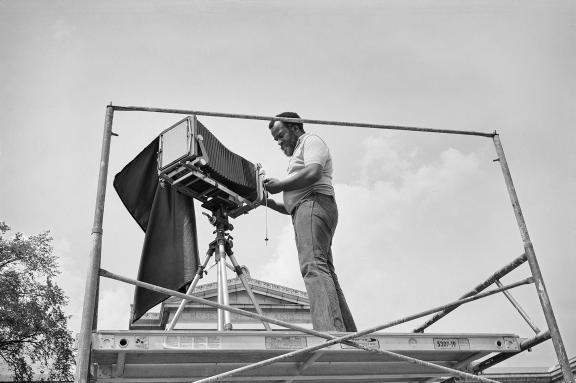
Robinson is no longer here for us to ask directly, so we may never know whether he chose the material for political and conceptual reasons, or if he was simply drawn to its beautiful tones and grain. We do however know that we exist in a moment when everyday acts, such as taking a moment to sit and rest during a museum visit, are neither neutral nor accessible for everyone. For some, choosing to please be seated will always be a political act. As a museum visitor, asserting the right to repose by taking a seat on a bench like Robinson’s is one way to absorb the galleries.
Robinson was acutely aware of social location and a sense of community, and he conveyed that in his photography, especially in his series looking at contemporary Black life in Europe in the mid-1980s. Funded by a grant from the Massachusetts Council for the Arts and Humanities and shot on location over six months, Robinson’s images range from a person incarcerated at the notorious Wormwood Scrubs prison in London to the director general of UNESCO in Paris. Esteemed curator Barry Gaither exhibited the series at the NCAAA in 1987, a year before Robinson succumbed to cancer at 51.
Next month, Robinson’s bench will move to the Art of the Americas Wing, where you can find it (and take a seat, should you wish) in a gallery exploring the vast network of known and anonymous craftspeople in the colonial Americas. Several other Please Be Seated works will join it throughout the galleries of 18th-century art of the Americas, including Joseph Van Benten’s Bardwell Settee (1982) and one of the earliest Please Be Seated commissions, Sam Maloof’s Settee (1975).
So, for a brief moment this summer, not one but two Boston museums will celebrate Rudolph Robinson and his work and legacy. The ICA exhibition closes August 2, but Robinson’s bench will be on display at the MFA indefinitely for visitors to enjoy. Here he will be part of a conversation that includes generations of makers before him who have navigated their own contexts and conceptual impulses in creating their work. Photography and woodworking can both rightly be considered forms of craft. Especially before the advent of digital cameras, knowing how to work the chemistry and timing of a dark room was as expert a skill as handling any chisel or saw. We’re lucky to hold a rare example of one part of Robinson’s craft, which survives as a testament to his rich and complex talent.
Thanks to Daisy Alejandre, Nonie Gadsden, Christine Storti, and Matthew Whiman for their great collaboration on this essay.